Expanded Narrative: The Nanticoke Indians............. Early Inhabitants of Maryland’s Eastern Shore
Life Along the Rivers and Tidal Waters of the Chesapeake
Long before the arrival of European explorers and settlers, the Nanticoke Indians inhabited the rivers, forests, fertile uplands, and tidal marshlands of Maryland's Eastern Shore. Their villages were commonly established along the higher ground bordering the region's waterways, providing access to productive farmland, abundant wildlife, fish, shellfish, and other natural resources. The Nanticoke, whose name is commonly interpreted as “People of the Tidewater,” were among the most prominent Indigenous peoples of the Delmarva Peninsula. Skilled farmers, fishermen, hunters, and traders, they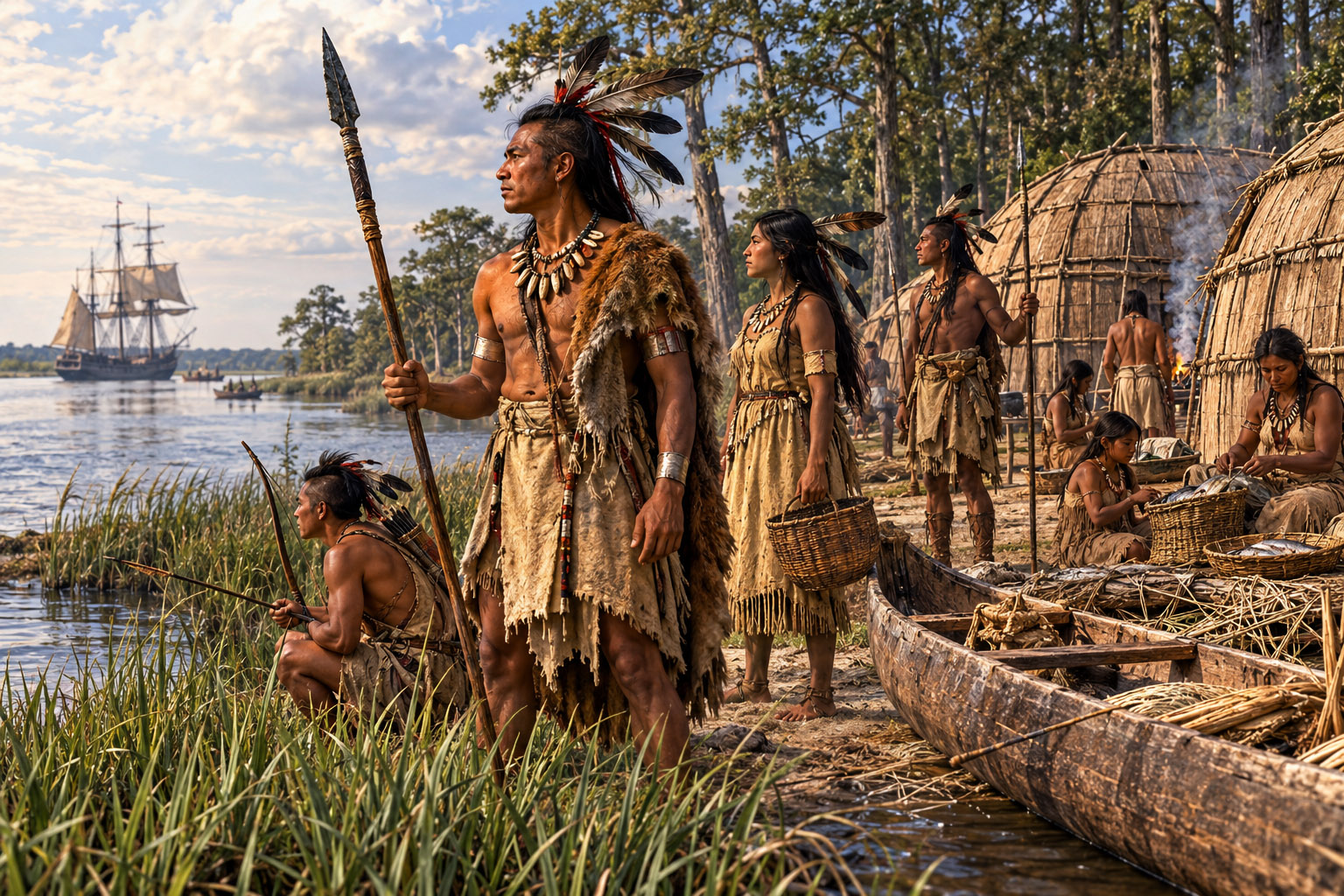 developed a thriving society sustained by the natural abundance of the Chesapeake Bay and its tributaries.
Their extensive knowledge of the region's rivers and creeks made them accomplished navigators. Using dugout canoes fashioned from large trees, they traveled the waterways, transported goods, harvested seafood, and maintained trading relationships with neighboring Indigenous communities.
Captain John Smith and the Nanticoke — 1608
The first recorded English encounter with the Nanticoke occurred in June 1608, when Captain John Smith and his crew explored the river he called the Kuskarawaok, now known as the Nanticoke River. Initially, relations between the English explorers and the Native inhabitants were cautious and occasionally hostile. According to historical accounts, Nanticoke warriors watched the unfamiliar English vessel from shore, some climbing trees for a better view. When Smith attempted to approach, arrows were reportedly fired toward his party.
- June 8–11, 1608: John Smith explored the Nanticoke River watershed. A National Park Service report identifies five Indigenous villages documented by Smith.
- 1668: Nanticoke leader Unnacokasimmon signed an early peace treaty with Maryland.
Smith withdrew to the river, anchoring his vessel overnight.
During the following days, the initial distrust gradually gave way to peaceful exchanges. Indigenous inhabitants approached the English in canoes, and gifts and provisions were traded. Eventually, several Nanticoke agreed to guide Smith farther along the river. Smith's observations recorded a substantial Indigenous population, including approximately 200 warriors living among several settlements along the river. He also recognized their considerable trading abilities, describing them as accomplished merchants.
Villages, Agriculture, and Everyday Life
The Nanticoke maintained established communities supported by agriculture, fishing, hunting, and the seasonal gathering of wild foods. They cultivated corn, beans, squash, pumpkins, sunflowers, and tobacco. The surrounding forests supplied deer, turkey, rabbits, and other game, while the rivers and marshlands provided oysters, clams, mussels, crabs, eels, and numerous species of fish. Their homes, commonly called wigwams, were constructed from frameworks of saplings covered with bark or woven mats. Larger buildings served community and ceremonial purposes. The forests furnished wood for dwellings, tools, weapons, and dugout canoes. Animal skins, bones, shells, and plant fibers supplied additional materials for clothing, ornamentation, and everyday necessities.
European Settlement and the Decline of Indigenous Communities
The arrival and expansion of European settlements during the seventeenth century profoundly changed the lives of the Nanticoke and neighboring Indigenous peoples. Diseases introduced through European contact, including smallpox and measles, contributed to population losses. Meanwhile, the clearing of forests, establishment of farms, expansion of colonial settlements, and appropriation of Indigenous lands increasingly disrupted traditional hunting, farming, and fishing practices. Relations between the Nanticoke and Maryland's colonial authorities deteriorated as competition for land and resources intensified. In 1668, Nanticoke leader Unnacokasimmon entered into a peace agreement with the Maryland colonial government. Additional agreements followed, but encroachment upon Indigenous lands continued.
Reservations, Displacement, and Migration
By the late seventeenth and early eighteenth centuries, Maryland authorities had established designated lands for Nanticoke communities, including the Chicone reservation and approximately 3,000 acres associated with Broad Creek. Although intended to provide a measure of security, these reservations restricted traditional patterns of seasonal movement and did little to prevent further encroachment.
By 1742, growing tensions had contributed to discussions among several Indigenous communities about armed resistance. A gathering at Winnasoccum became associated with an alleged plan to challenge colonial authority. During the following decades, many Nanticoke families departed their ancestral settlements. Some traveled north toward Pennsylvania and New York, establishing relationships with other Indigenous nations. Others relocated into present-day Delaware, particularly the Indian River region. Not all Nanticoke left the Eastern Shore. Families remained throughout the region, maintaining their identity, kinship networks, and cultural traditions despite considerable social and political pressures.
The Nanticoke Legacy
The Nanticoke people did not disappear with European colonization. Their descendants continued to live throughout Delmarva and beyond, preserving their heritage through family traditions, community relationships, and organized tribal institutions. The Nanticoke Indian Tribe of Delaware traces its state recognition to 1881. The Nanticoke Indian Association was established in 1921, and the Nanticoke Indian Museum opened in 1984 to preserve and share the tribe's cultural heritage.Today, the Nanticoke remain an important and living part of the history of the Delmarva Peninsula.
Their story reminds us that the maritime traditions of the Chesapeake Bay did not begin with European explorers, colonial settlers, or the sailing workboats of later centuries. Long before the first English vessel entered the region, Indigenous peoples were navigating these waterways, harvesting their resources, and establishing traditions of waterborne transportation and trade that formed an essential part of the Chesapeake's earliest maritime history.