| Bay Journal
Timothy B. Wheeler & Jeremy Cox
https://www.bayjournal.com/news/fisheries/amid-oyster-bounty-chesapeake-bay-watermen-suffer-dismal-harvest/article_7119996a-3b03-4d0a-82dc-9c3678ea0b93.html
It’s the best of times in recent memory for Chesapeake Bay oysters. It’s just the opposite, though, for the Maryland and Virginia watermen who make a living harvesting them.
The Bay’s oysters have recovered from the MSX and Dermo diseases that decimated the population a little more than two decades ago. Recent reef surveys found them more abundant and fecund than they’ve been since the diseases hit in the late 1980s.
That’s good news for the Bay because oysters are a keystone species that help filter the water. They also build reefs that provide habitat for fish, crabs and other marine life.
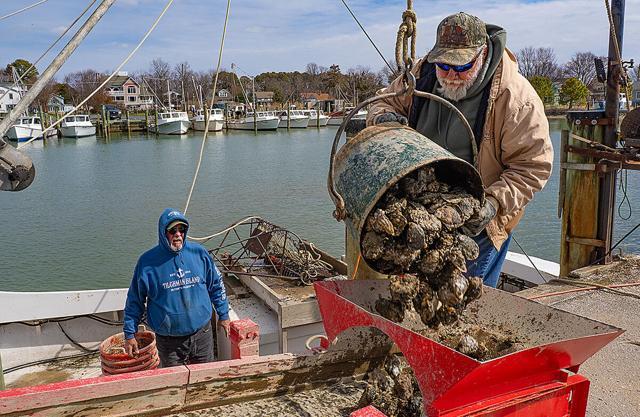
Until recently, the oysters’ comeback was good for watermen, too, as they enjoyed increasingly robust wild harvests. The bounty peaked in the 2022-2023 season, with landings in Maryland of 723,000 bushels — the highest in 36 years. Virginia’s harvest from public and privately leased oyster grounds likewise topped 700,000 bushels then, also the best since the late 1980s.
This season, though, oyster landings have plummeted, as have the prices paid to watermen for their catch. In Maryland, midway through the six-month season — normally from Oct. 1 to March 31 — the harvest was running 44% below what it had averaged the previous five years. Prices paid to watermen were down even more at 66% below the five-year average.
“It’s been a terrible year, one of the worst that I’ve ever seen,” said Jeff Harrison, head of the Talbot Watermen Association. His group set up a relief fund to help watermen who might be in financial distress.
Watermen in both Maryland and Virginia say the 2025-2026 wild oyster harvest season has been hammered by a triple whammy: a glut of oysters nationally, icy weather and a flurry of bad PR for oysters.
Warning that Maryland’s oyster industry faced devastation, Gov. Wes Moore in late February asked U.S. Commerce Secretary Howard Lutnick for federal disaster assistance to help watermen weather their economic crisis. Moore’s request followed one submitted weeks earlier by U.S. Rep. Andy Harris, whose district covers the Eastern Shore.
Harris, Maryland’s lone Republican member of Congress, said that the season was affected by “a confluence of factors that individually weren’t so bad.” But “taken together,” they all but ruined the industry’s fortunes in Maryland.
“Our watermen are pretty resilient,” he added. “They’re like our farmers. They have good years and bad years. But if you have a couple bad seasons in a row, then you’re in trouble.”
But problems with selling their harvest began well before that frigid snap and continued after the ice melted. By Thanksgiving, when consumer demand for oysters is normally peaking, many watermen found that their usual buyers were limiting how many bushels they would take. Some declined to take any oysters for part or most of every week.
It didn’t help when news broke in late December of a nationwide salmonella outbreak that the U.S. Centers for Disease Control and Prevention linked to eating raw oysters. Eighty people were sickened over seven months in 23 states, including three in Maryland and six in Virginia, with no reported deaths. Investigators were unable to pin down a common source for the illnesses.
Then, in late January, a huge sewer line near the District of Columbia ruptured, releasing a massive wastewater spill into the Potomac River. Maryland regulators ordered a precautionary closure of oyster harvesting for 60 miles downriver to the U.S. 301 bridge. Even though monitoring detected no problems, the closure wasn’t lifted until March 10. Meanwhile, distributors and consumers became even more skittish about buying oysters from farther down-river in the Potomac and elsewhere in the Bay.
It added up to a “perfect storm” of economic challenges for the Chesapeake oyster industry, said Andrew Scheld, a fisheries economist with the Virginia Institute of Marine Science.
The region’s oyster industry might be becoming a victim of its own success, Scheld suggested. The oyster population rebound that enabled harvests to increase ultimately outpaced the market for them. Now, recent surveys show that the oyster biomass — the overall weight of oysters in the ecosystem — is at an all-time high in more than 30 years of recordkeeping and more than five times higher than the population’s low point in 2002.
“There are plenty of oysters out there. They’re just not being harvested,” said Mitch Tarnowski, who leads an annual survey of Maryland’s oyster reefs for the Department of Natural Resources.
The same was true farther south. J.C. Hudgins, president of the Virginia Watermen’s Association, said in early March he’d had no trouble hitting his boat’s 16-bushel limit, usually within two hours, on the Piankatank River. But, he added, this past season was the worst for selling the harvest in 25 years.
Less demand for oysters
Like virtually every oysterman, Hudgins didn’t go out on the water in the morning unless he heard that his buyer would be purchasing his catch at the end of the day. During the season’s lowest point in January, he was unable to work for seven out of a possible 22 days. Some harvesters were stuck at the dock for up to 12 days.
Wholesale buyers said they had to cut back on what they bought because they were getting fewer orders from restaurants and seafood markets.
Jason Ruth, owner of Harris Seafood Co., which buys and shucks oysters at a plant in Grasonville, MD, said the Bay’s oyster industry is being squeezed by competition from other states and generational shifts in seafood consumption.
Over the past decade, Ruth said, the Chesapeake oyster industry has been “propped up” by slumps in yields in Louisiana, Texas, North Carolina, Mississippi and Florida.
But this year, other states’ estuaries are brimming with oysters, too.
“With Florida and Mississippi reopening,” Ruth explained, “the entire industry is flooded with product, causing reduced prices and low demand. Most processors are now only buying what they can sell locally rather than outsourcing [to] other states, which directly impacts the watermen’s ability to work daily.”
Ruth said his company “managed relatively well despite declining sales” because it has a “diverse clientele and product line” that buffered it from the declines affecting other buyers who rely more heavily on shipping oysters to surrounding states.
Even so, Ruth said the industry as a whole is suffering from a gradual shift in consumer tastes.
“While the demand for boutique aquaculture oysters has grown over the last decade,” he said, “the shucked oyster sector — the larger part of the industry — has seen a 60-year nationwide decline.” Rising production costs and trends toward healthier eating have weakened sales because “shucked oysters are primarily used for fried dishes or heavy stews, which are less popular today.”
“People aren’t going to spend $20 for a pint of oysters,” Hudgins agreed. “It’s pretty expensive eating. I think people are feeding their families in other ways.”
Federal disaster relief
In response to the prolonged sub-freezing weather, Maryland’s Department of Natural Resources (DNR) extended the wild oyster season by two weeks until April 14. While watermen welcomed the gesture, many weren’t sure it would help much if they still couldn’t sell their harvest.
Federal disaster assistance, if granted, could provide Maryland with some funds to throw an economic lifeline to cash-strapped watermen. There is precedent. In 2008, the National Oceanic and Atmospheric Administration gave Maryland and Virginia $10 million each after blue crab harvests plummeted for unknown reasons. That money paid watermen for off-season work to retrieve derelict crab pots and perform oyster reef upgrades.
Federal help is far from assured, though, and might take months to materialize.
“We won’t be the only ones asking for disaster relief,” DNR Secretary Josh Kurtz cautioned concerned Eastern Shore legislators. |