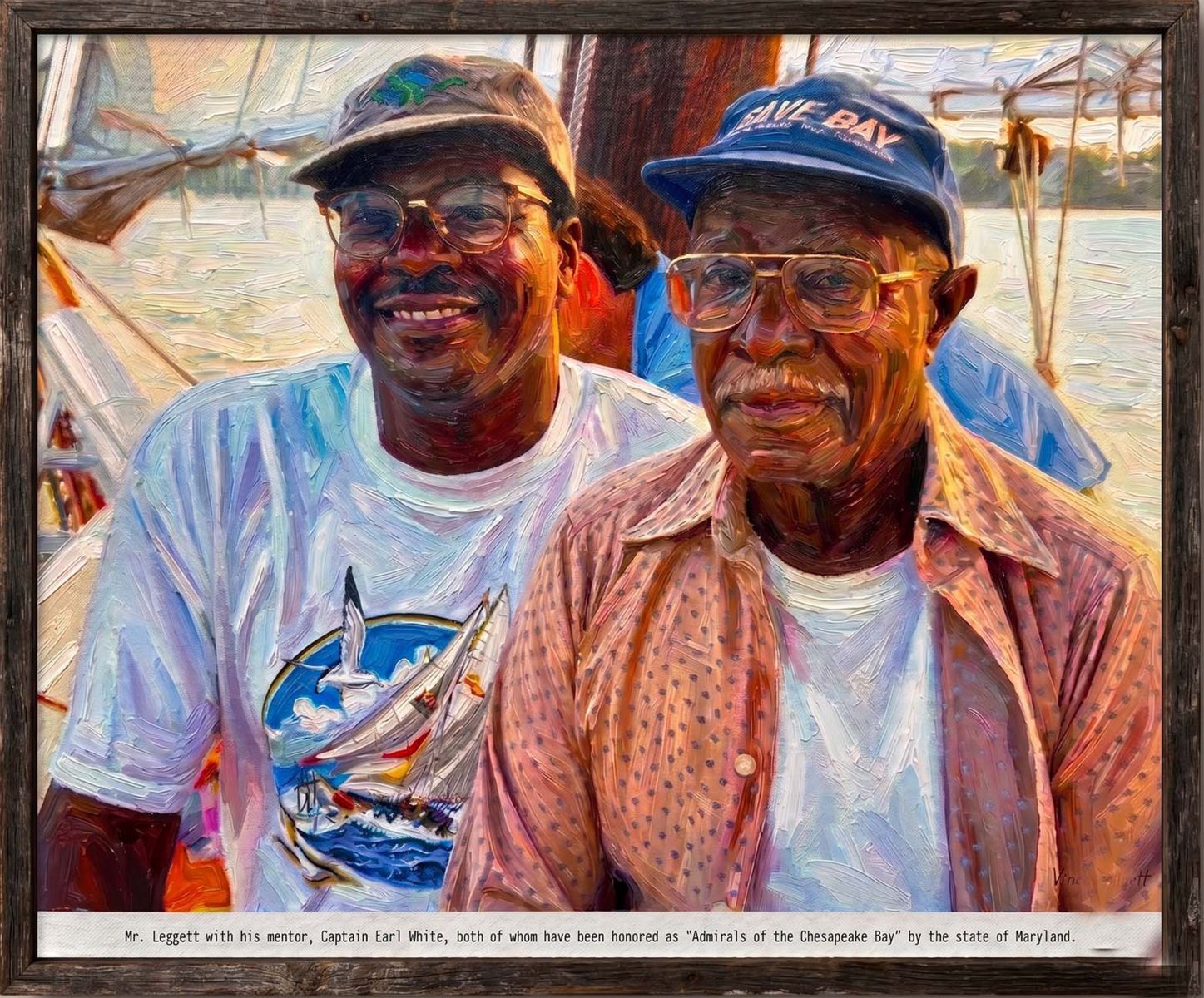
Vince Leggett (1953 - 2024) "middle"The is the founder of the Blacks of the Chesapeake Bay Foundation and author of "TheChesapeake Bay Through Ebony Eyes."
Credit Blacks of the Chesapeake who work to share the legacy of African-American achievement in the Bay's seafood and maritme industries, support the economic success of those industries and foster environmental preservation and conservation Capt. Earl White (1919 - 2004) "left" from Deal Island
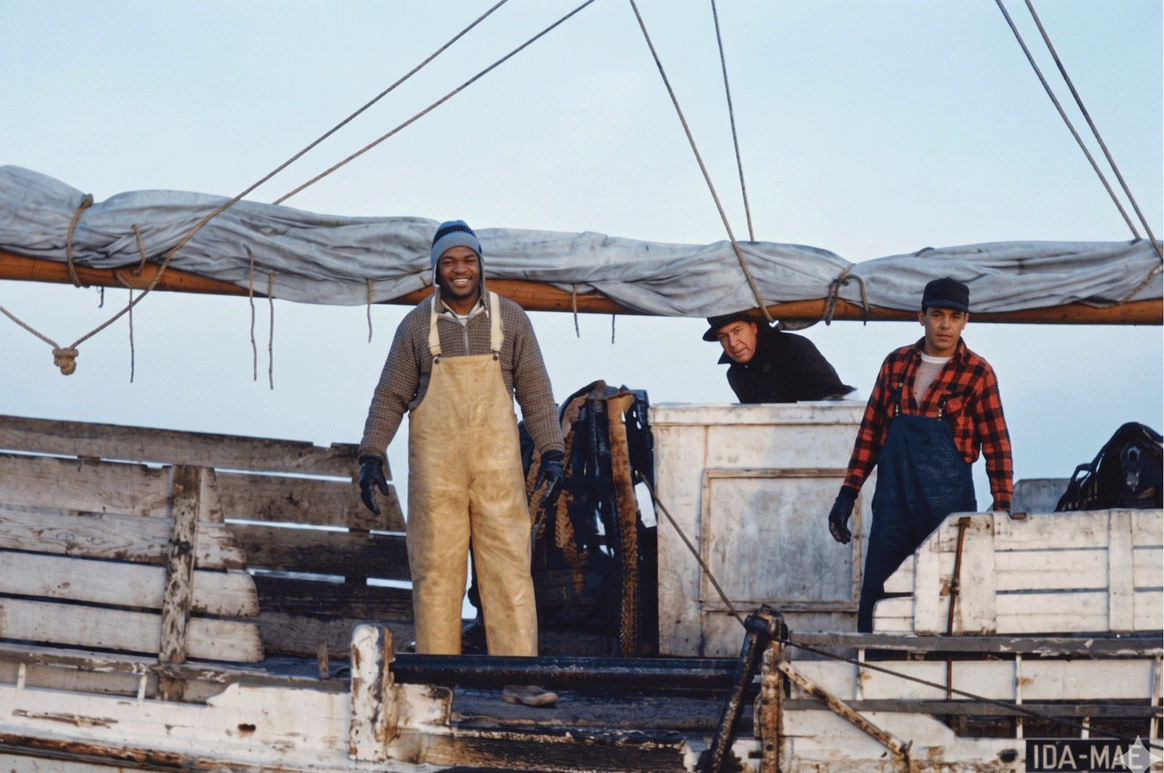
Captain Kermit Travers who once captained the
Skipjacks H.M Krentz and Ida May.
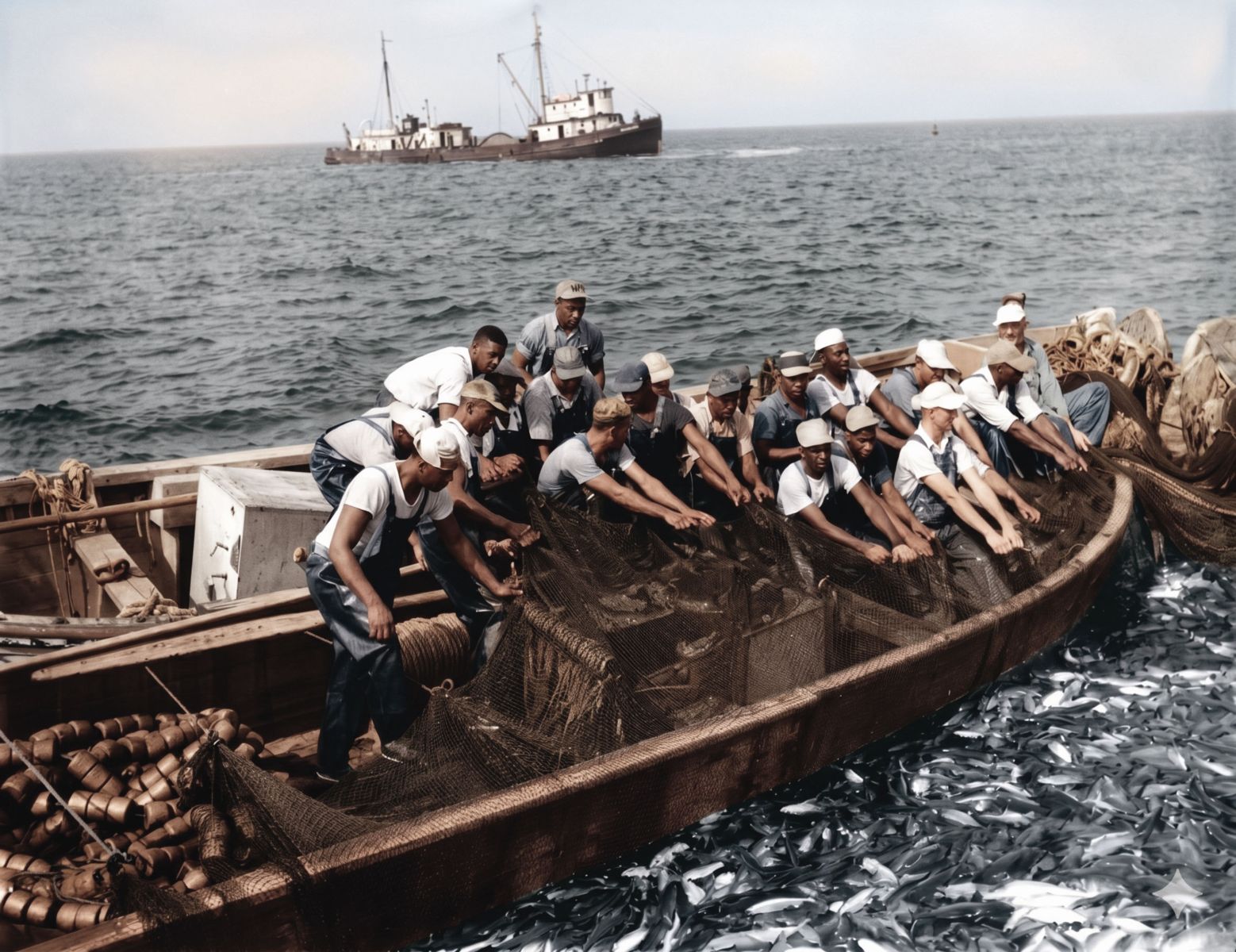
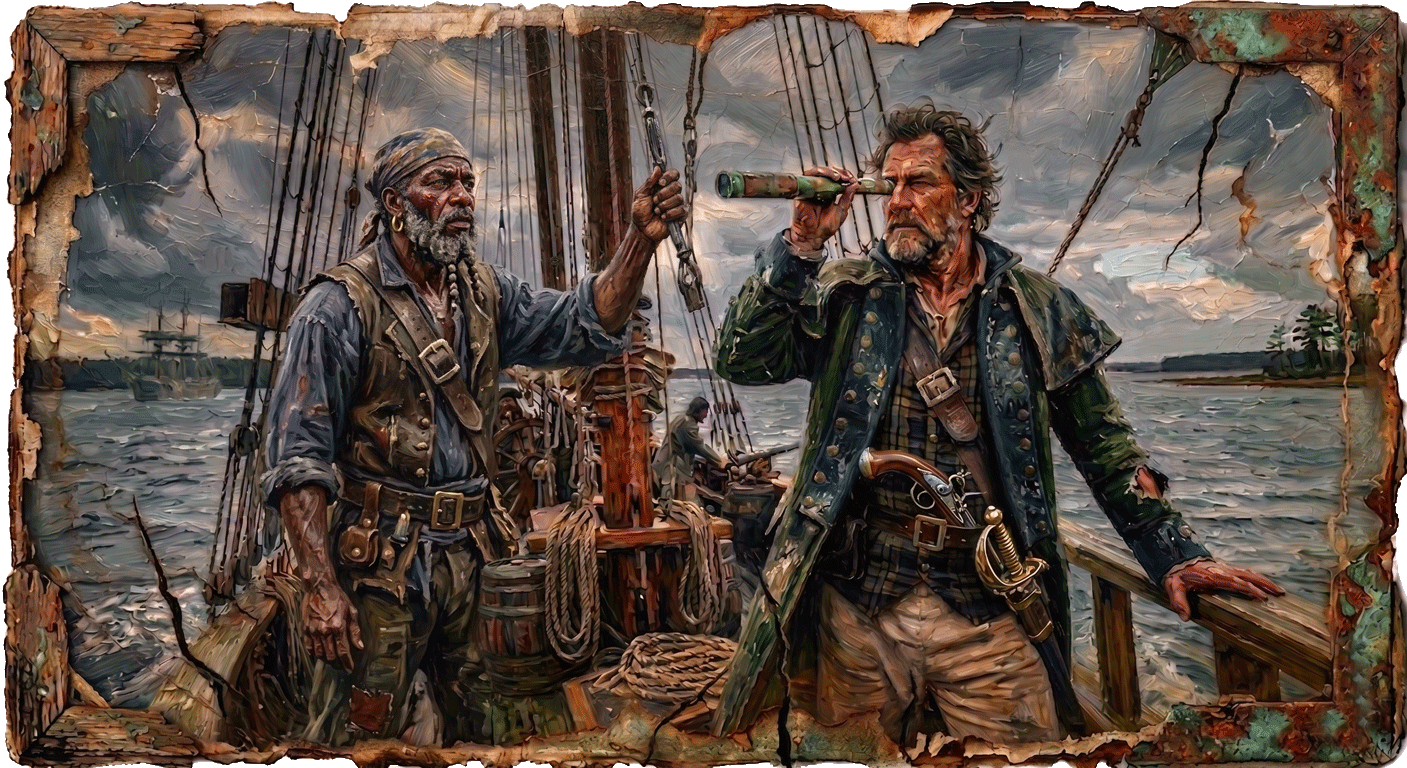
The Black watermen of Deal Island, Maryland, represent a centuries old maritime tradition that once formed the backbone of the Chesapeake's seafood industry. Historically, these skilled sailors, shipbuilders, and oyster harvesters—often referred to as "Black Jacks"(Black Jacks" was a nickname for African-American sailors who served on American merchant, sailboats, vessels during the 18th, 19th and 20th centuries)—found a rare degree of economic independence and dignity on the water, even during the era of slavery.
Historical Significance & Community
Deal Island was home to thriving Black communities, particularly in areas like Dames Quarter and Wenona.
Economic Opportunity: Oystering was one of the highest-paying jobs available to Black men in the 19th and early 20th centuries.
Freedom and Citizenship: Black watermen were among the first African Americans to be legally recognized as citizens, often carrying "Seaman's Protection Certificates" to prove their status.
During the Revolutionary War many formerly "enslaved men escaped and joined British forces, loyalist tory pirates" not only seeking freedom from American bondage, but also because their intimate knowledge of the Chesapeake’s shoals, creeks, and hidden harbors made them indispensable as pilots and guides.They often guided the British back to their former slave ovner homes, plantations where the British plundered looted them of property, food livestock, boats, valuables even stealing their young sons to serve for the British.
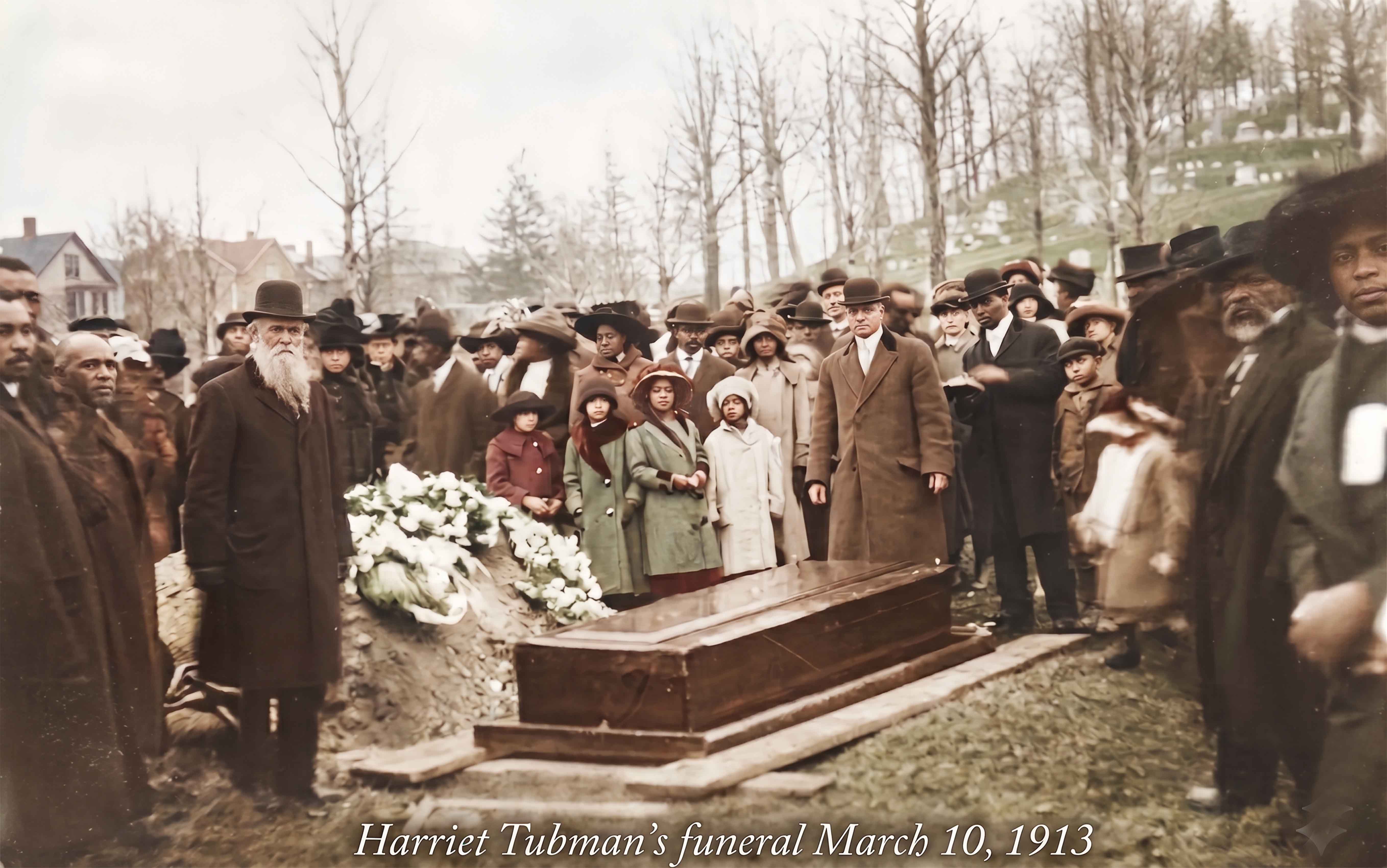
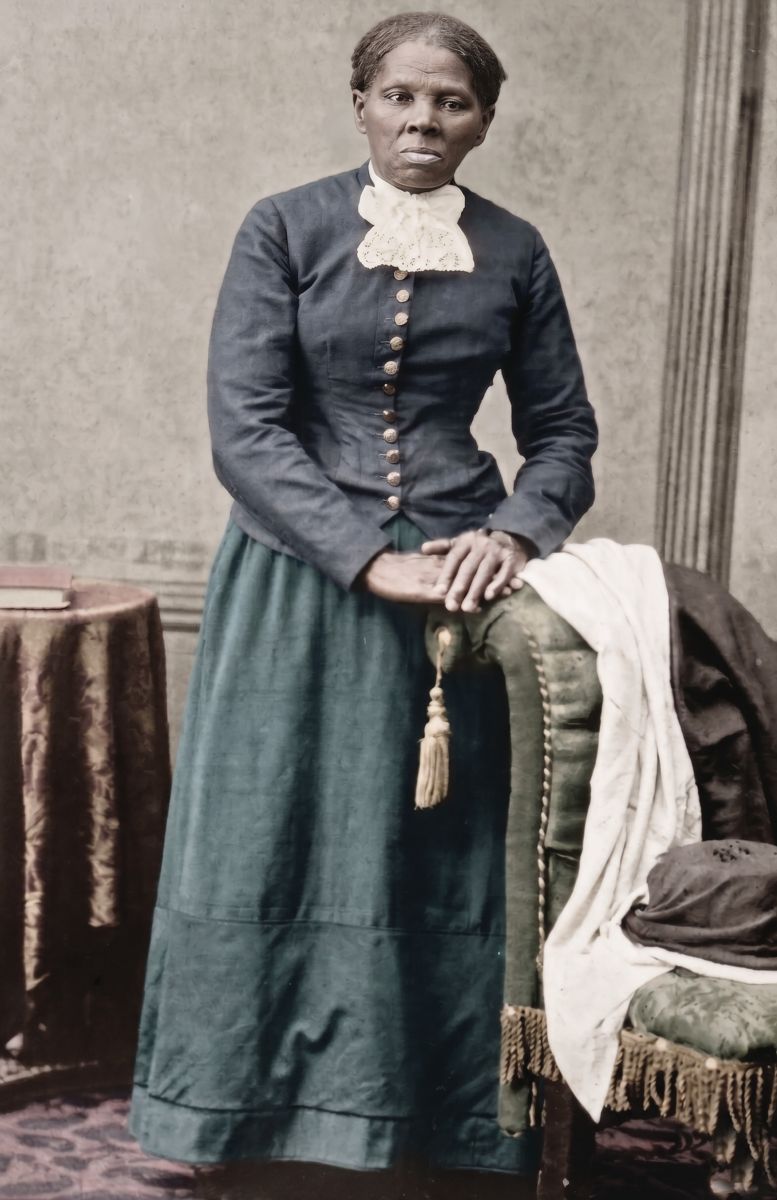
Underground Railroad: Their expertise as navigators was critical; many used their positions to pass information or transport enslaved people to freedom. Black watermen were expert navigators who used their boats and a "lantern code" to secretly transport enslaved individuals to freedom, leveraging their deep knowledge of the Bay's complex waterways. Harriet Tubman was very much involved, coordinated and help rescue slaves looking for freedom.
Water Crossing Signals: Black watermen and conductors used specific flashes of lanterns to communicate at night across rivers, such as the Ohio River, to indicate when it was safe to cross or to meet a boat.
Safe House Signal: A lighted lantern in a window, or sometimes a lamp, served as a beacon marking "stations" (safe houses) where fugitives could find refuge, particularly at the John Rankin House in Ohio.
Signal Meeting: A white cloth or specific quilt pattern (like "flying geese") displayed on a fence or window often indicated a safe house, while the lantern confirmed it was safe to approach.
These signals were part of a broader, secret communication system that included special songs, knocks, and codes like "friend of a friend" to safely navigate freedom seekers northward.
The Chesapeake Bay Maritime Museum campus was once the site of the Coulbourne & Jewett seafood packing house, a large "Black-owned" business that operated from 1902 to 1962.
Historic Figures:
Frederick Jewett is credited with creating the five-tier system still used today to grade crab meat.
Current Exhibits:
Explore stories of enslaved individuals seeking freedom via water routes in "Sailing to Freedom" and "Bear Me Into Freedom" exhibits, running through 2027.
Current Challenges: Climate & Racism
Today, the legacy of Black watermen on Deal Island is under threat from both environmental and social factors:
Environmental Justice: The documentary Eroding Historyhighlights how historical racism forced Black communities into lower-lying, flood-prone lands, which are now being lost to rising sea levels and erosion.
Declining Numbers: While there were once hundreds of Black watermen on the Eastern Shore, their numbers have dwindled to fewer than 20 today.
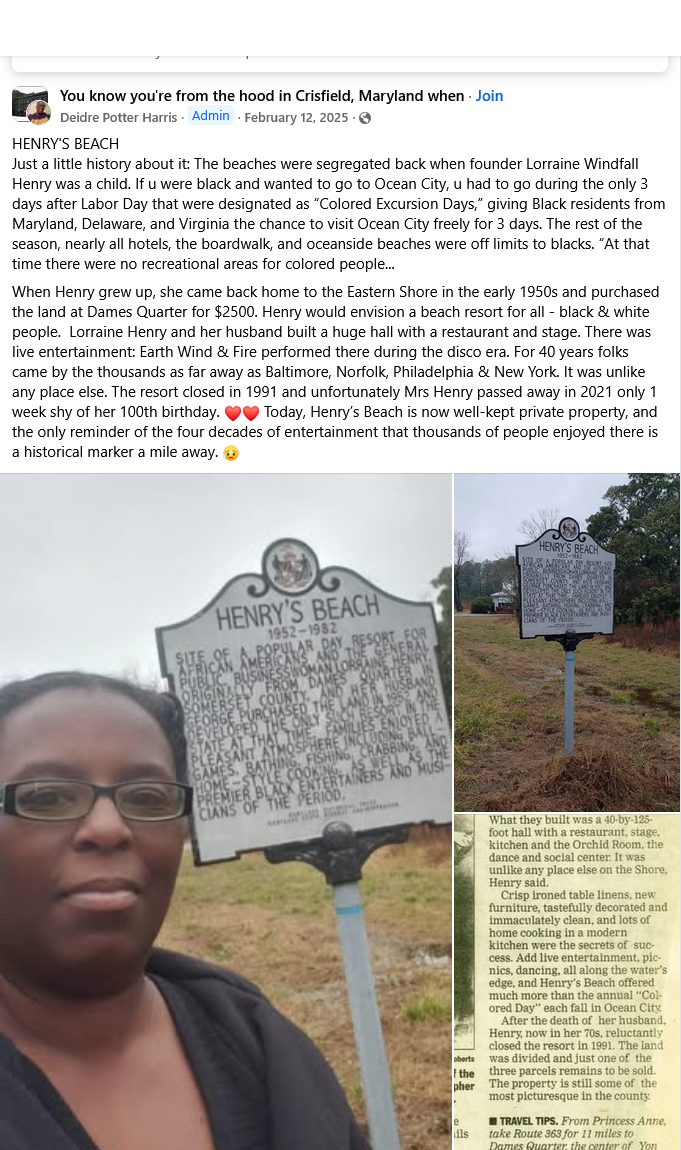
Henry's Beach, located in Dames Quarter near Deal Island, MD, was
Key Details About Henry's Beach:
Location: The historic site is situated at the intersection of Deal Island Road (MD 363) and Hudson White Road in Dames Quarter, Somerset County, Maryland.
Historical Significance: It was one of the few places on the Eastern Shore where Black families could visit, dine, and relax during segregation, operating as a bustling, friendly, and integrated hub.
Legacy & Amenities: Owned by Lorraine Henry, the venue featured a restaurant, bar, and dancing, with notable performances in the 1970s. It was deeply embedded in the local culture, known for activities like Sunday school by the water.
Current Status: The beach was sold in 1991 and is now private property, but its legacy is marked by a Maryland Historical Trust marker.
A Legacy of African-American Watermen on the Lower Delmarva
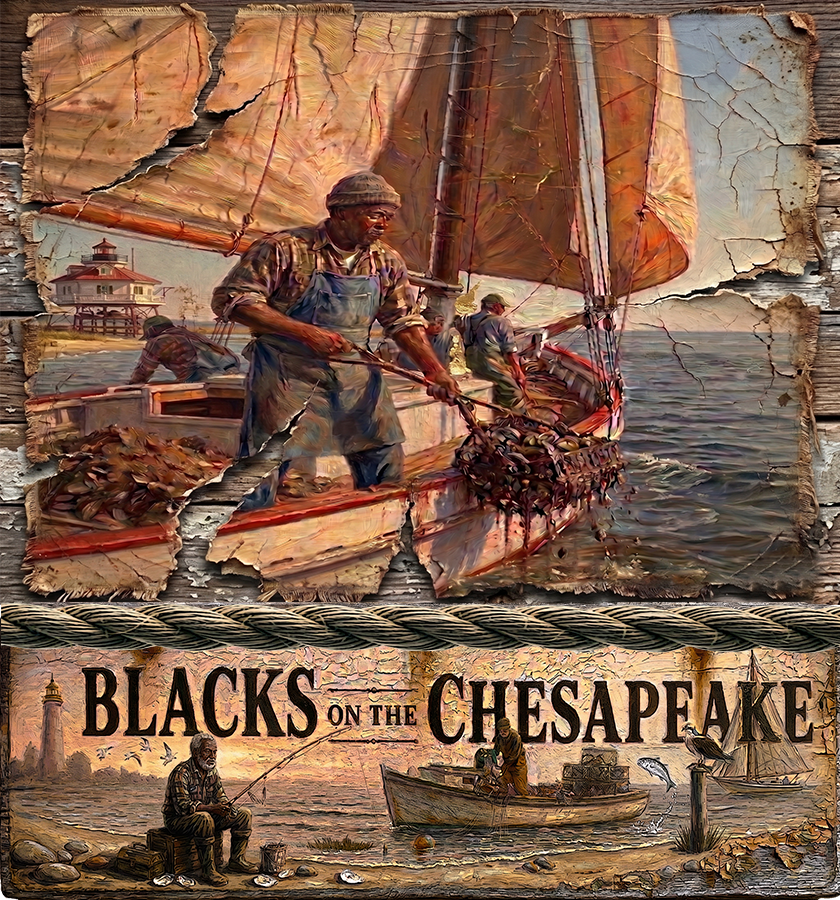
Along the shores of the Chesapeake Bay, generations of African-American watermen built lives tied to the tides. From the late 19th century through the 20th, men and families across the Lower Delmarva Peninsula worked the waters as oystermen, crabbers, fishermen, and boatmen—forming a vital yet often overlooked part of the region’s maritime heritage.
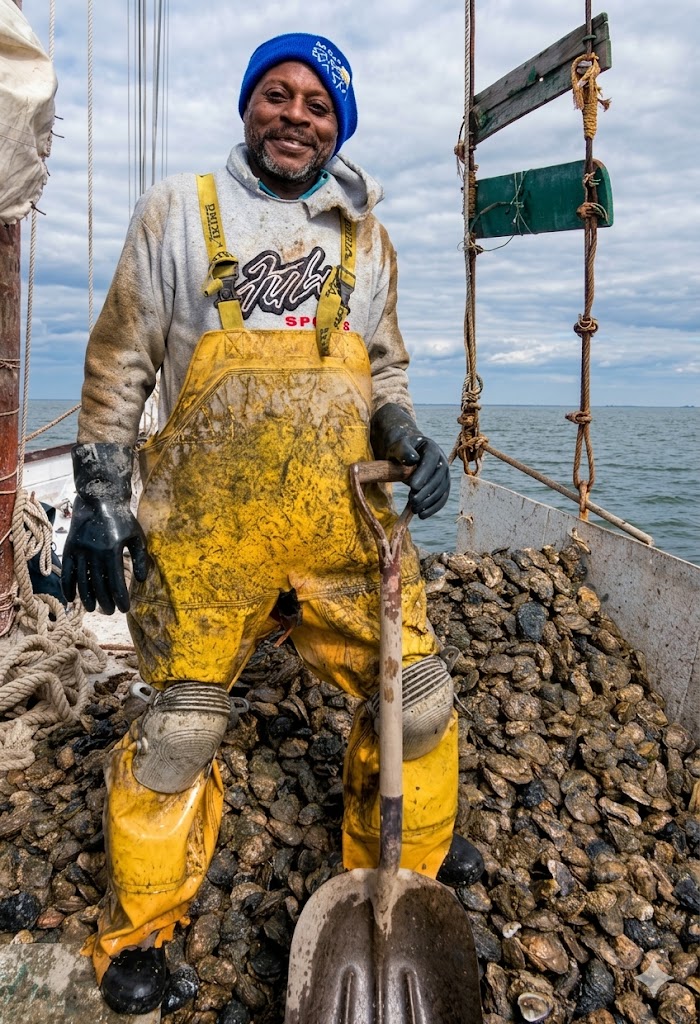
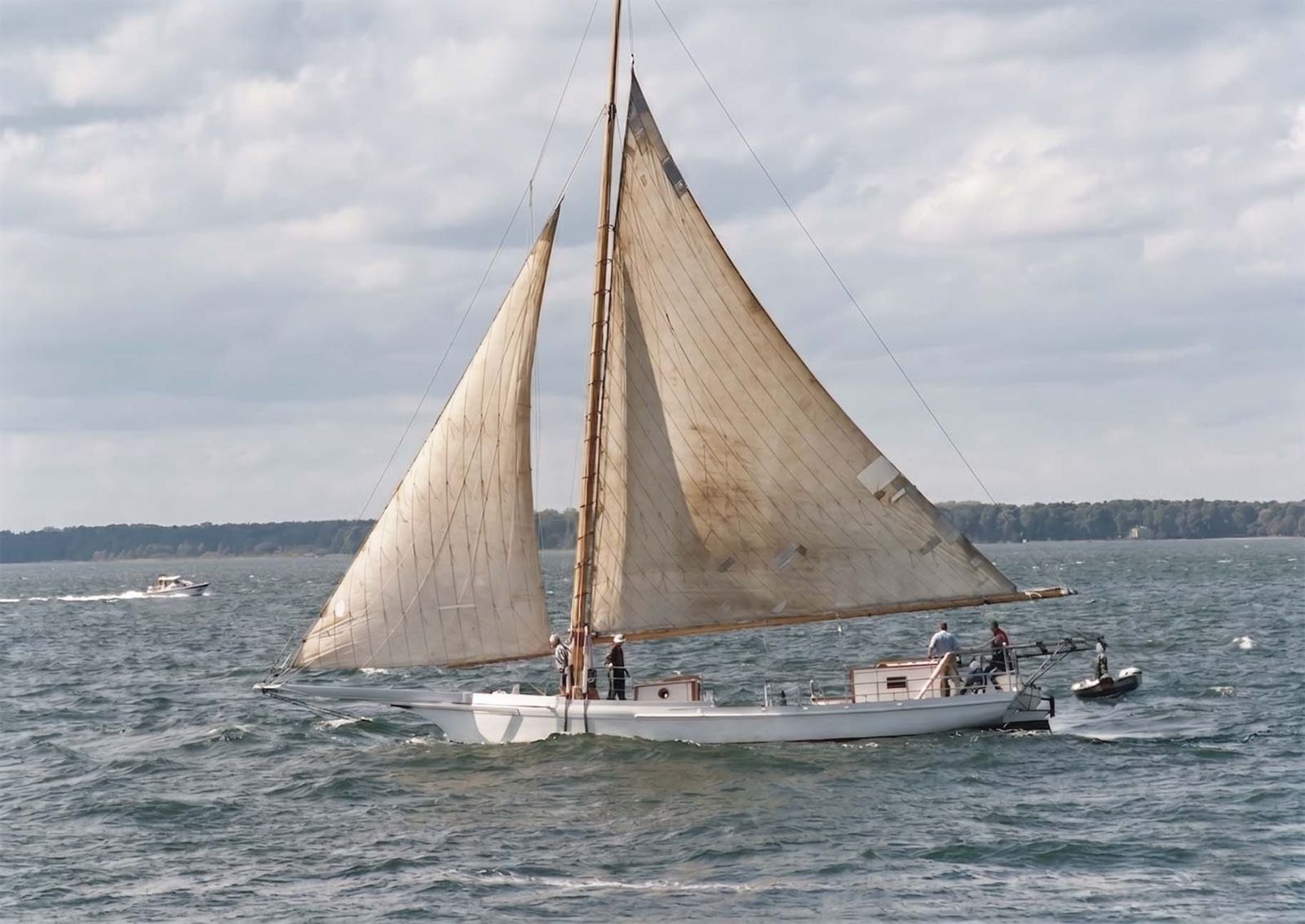
Working aboard vessels like the Skipjack and traditional deadrise boats, these watermen harvested oysters from the Bay’s beds, tonged in the shallows, and labored through long seasons shaped by weather, markets, and the rhythms of the water. Their knowledge of currents, shoals, and harvest grounds was earned through experience and passed down through generations.
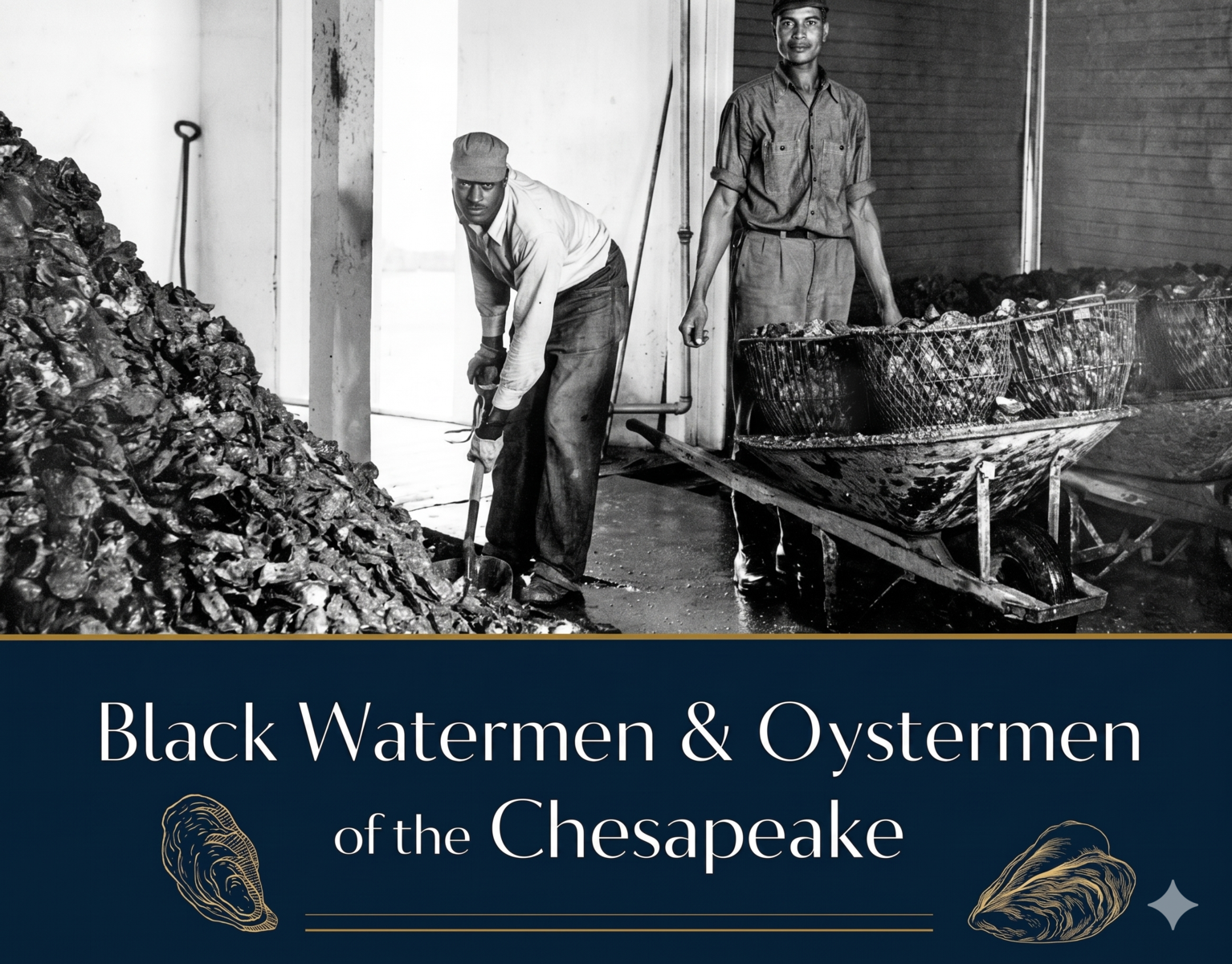
Communities throughout the Lower Eastern Shore—places like Deal Island and neighboring waterways—were home to Black watermen whose work extended beyond the boats. Families often participated in seafood processing, shucking houses, net mending, and boat maintenance, creating a culture deeply rooted in cooperation, skill, and resilience.
Despite facing segregation and limited access to resources, African-American watermen carved out livelihoods on the Chesapeake, sustaining families and preserving traditions that remain part of the Bay’s identity today. Their stories are not only about labor—but about heritage, pride, and connection to one of America’s most historic working waterways.
Today, organizations like the Blacks of the Chesapeake Foundation continue to preserve and share these histories, ensuring that the voices and contributions of Black watermen are recognized as an essential part of Chesapeake Bay culture.
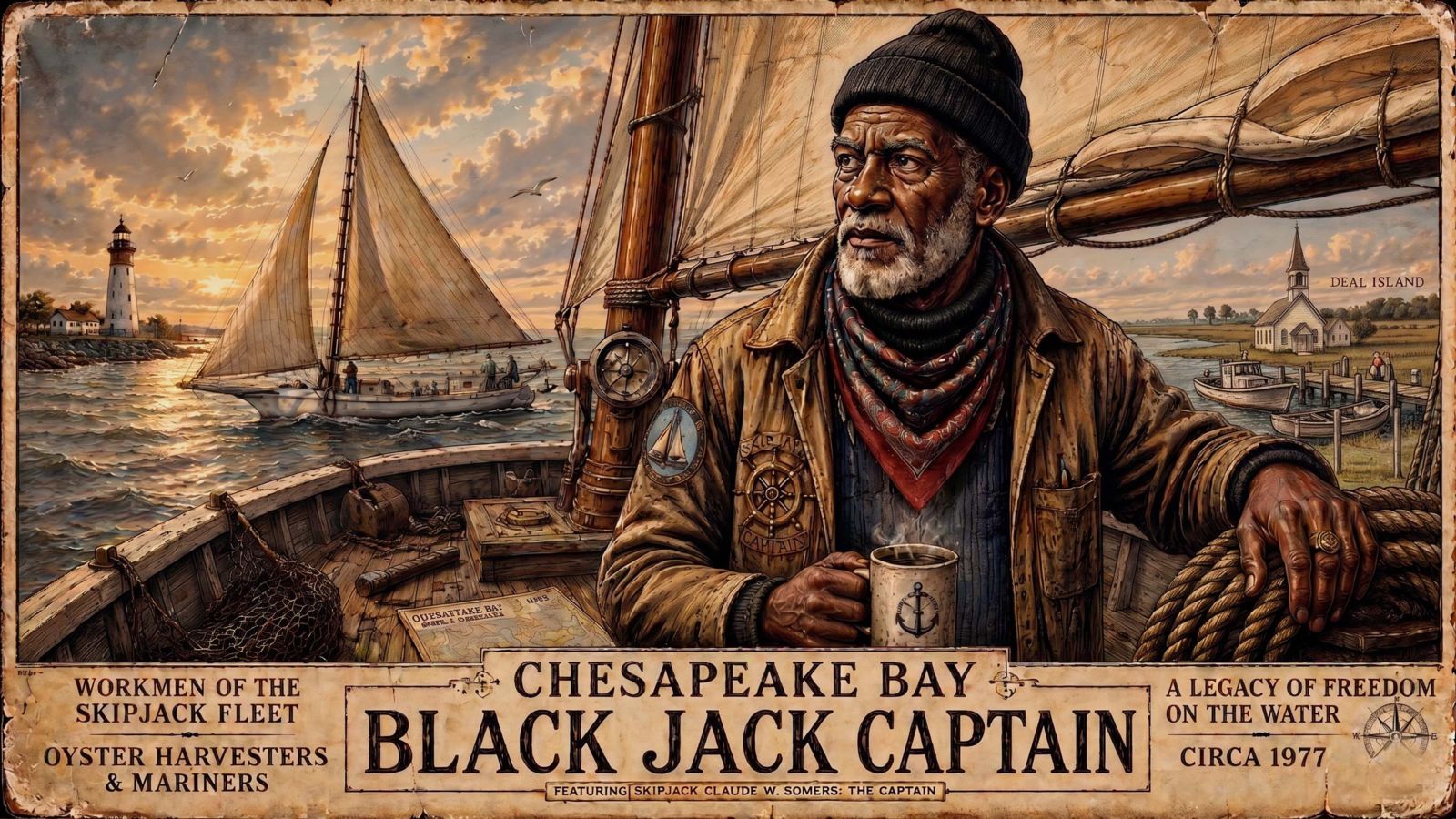
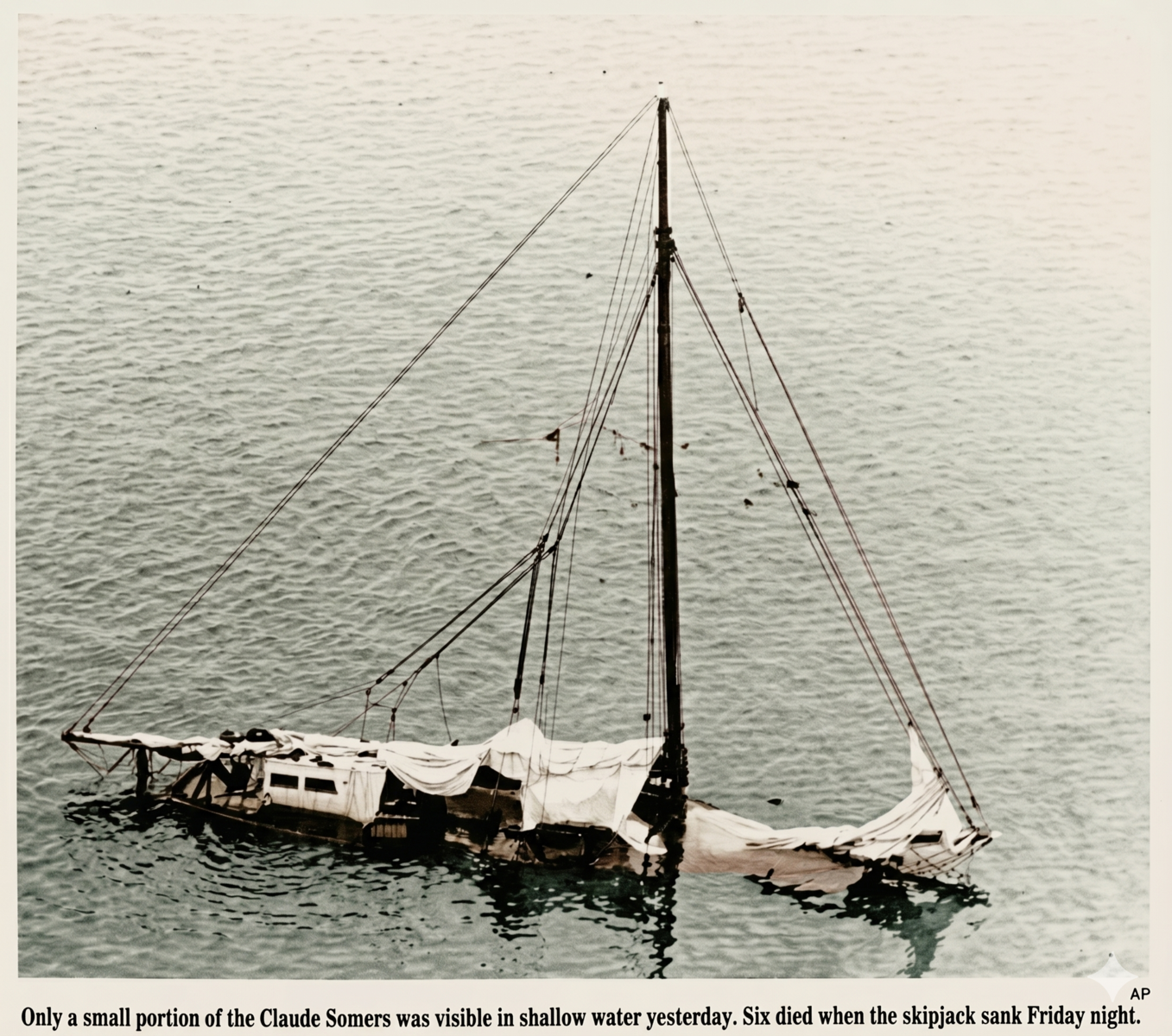
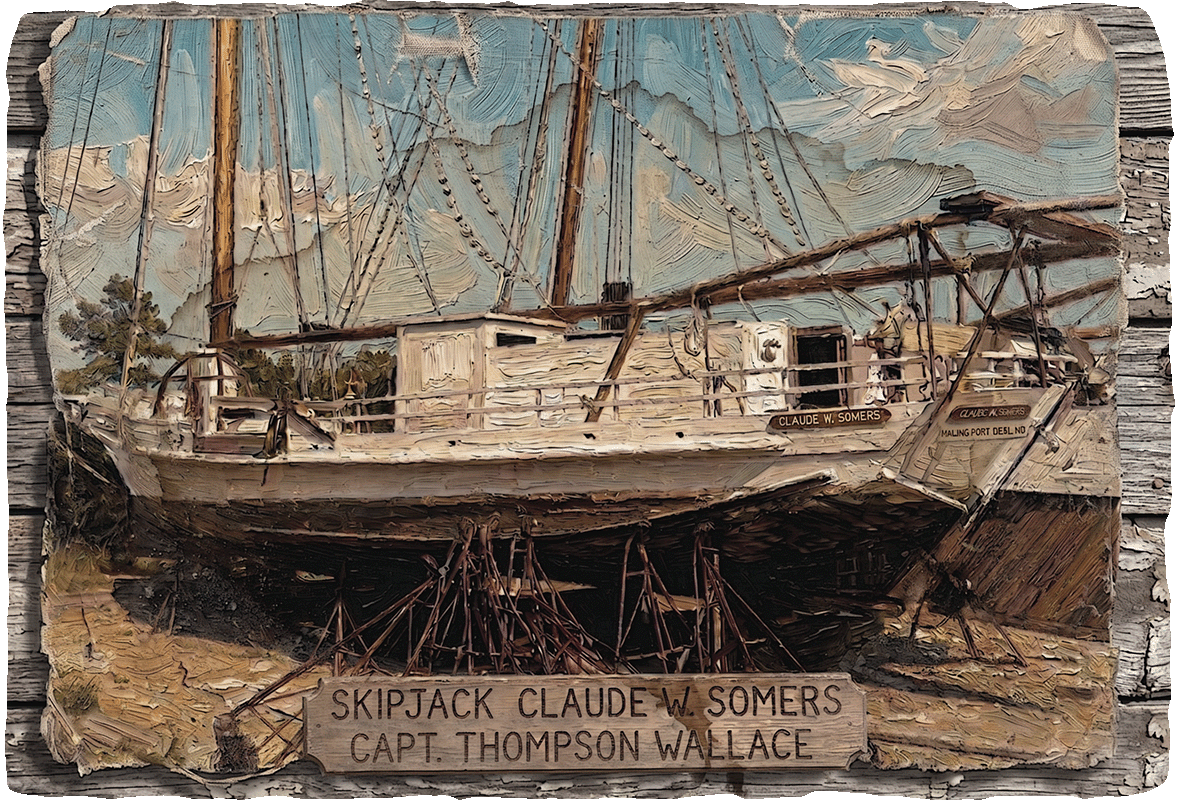
The Claude W. Somers (often spelled Claude W. Somers), a 1911 Chesapeake Bay skipjack, sank on 4 March 1977 during a sudden and violent wintry gale in Hooper Strait, near Hooper Strait Light and Hooper’s Island.
The disaster was particularly tragic because it claimed the lives of all six crew members on board, including the owner and captain, Thompson Wallace, one of the last Skipjack captains on the Chesapeake Bay.
Key Details of the Sinking
Cause: The vessel was struck by a powerful squall with reported winds of up to 75 mph and waves reaching 15 feet.
Location: It went down in about 12 to 15 feet of water in Hooper Strait, which lies between the Honga River and Tangier Sound.
Historical Significance: Captain Thompson Wallace was one of the last Black captain-ownersof a skipjack on the Chesapeake Bay.
Restoration and Current Status
Following the tragedy, the vessel was eventually salvaged and changed hands several times. In 1983, it was purchased by Alfred Garey Lambert, who spent 17 years restoring it.
Museum Display: In May 2000, it was donated to the Reedville Fishermen’s Museum in Virginia, where it remains an operational exhibit.
Historic Registers: It is listed on the National Register of Historic Places in both Maryland (1985) and Virginia (2005).
Current Use: The museum offers organized sails and tours, allowing visitors to see the interior and experience a working skipjack.
Legacy: Wallace faced significant discrimination in attempting to secure a boat before finally acquiring the Somers, a common struggle for Black watermen at the time.
Crew: The tragic event claimed the lives of Wallace and his crew, including relatives.
Operation: Wallace, based out of Chance, Maryland, was known for his dedication to the dredging tradition, which was in sharp decline.
The vessel went down in relatively shallow water (approximately 12–15 feet) in Hooper Strait.
While it was on the bottom, the primary focus of local authorities was the recovery of the bodies of Captain Thompson Wallace and his five crew members. The ship was salvaged later that year, and photos from that era typically show it either before the disaster as a working oyster boat or after it was raised and began its long road to restoration.
A Black boating tradition on the Chesapeake ran into racism — then tragedy
Washington Post, 26 November 2022
On March 4, 1977, Capt. Thompson Wallace maneuvered his skipjack, the Claud W. Somers, out of a Deal Island harbor on Maryland’s lower Eastern Shore. Aboard were his seasoned crew of six, all but one of whom were members of his family. The Chesapeake Bay had finally thawed after weeks of a solid freeze, and the captain, like many of the island’s watermen, was hoping for a good workday. They never came home. A March gale sank the Claud W. Somers — and ended a tradition of Black skipjack captain-owners on the Chesapeake Bay. Thompson was one of the last two Black captains to dredge for oysters under the shallow-draft, two-bateau wooden sailboats built for Chesapeake oyster dredging. Many of the remaining skipjacks are now berthed at Chesapeake maritime museums. The restored Claud W. Somers is on display outside the Reedville Fishermen’s Museum on Virginia’s Northern Neck, where tourists peer into her sleeper cabins during organized sails.
Stories abound about the majesty of skipjacks, but little has been written about one of the worst accidents in Chesapeake history, and how it hastened the dwindling of Black watermen’s participation in a once robust oyster fishery. “For a long time, I didn’t know that story,” said Vince Leggett, founder of Blacks of the Chesapeake Foundation, which has been chronicling Black maritime achievements for the past 40 years. “It was a story buried in an unmarked grave.”
‘Don’t let him have it’ Wallace was born in 1922 on Deal Island, one of 14 surviving children out of 23 in a family of watermen. He quickly became known as one of the best boatwrights. He could fix anything, recalled the Rev. William Wallace, one of his sons. Thompson Wallace wanted to buy his own skipjack. The local banks rejected him four times; to get the boat, William Wallace said, his father had to travel 45 minutes away. And the boat’s owner, Jack Parkinson, had to be willing to sell it to him, mostly because he knew Thompson Wallace could fix it up and run it. “There were those who didn’t want him to have it because they wanted him to work for them, those who whispered, ‘Don’t let him have it,’ ” said William Wallace, now 71, who often oystered on his father’s boat and was involved in the discussions. “That had to do with his race. They didn’t want him to be enterprising. They wanted him to work for them.” According to William and his brother Kevin, oyster buyers sometimes refused to take their father’s catch but bought everyone else’s. In the spring, Thompson crabbed, and when buyers counted crabs, the brothers said, his father often got shorted.
Leggett calls such discrimination “sharecropping the bay” and said it was common in the Jim Crow era for White watermen to block Black watermen from owning boats. In 1916, there were 13 Black captains among the 178 watermen who applied for dredging licenses in Somerset County. By 1977, only two Black captains had dredging licenses there, though many Black men worked on boats as cullers and deckhands. The decline in boat ownership had much to do with a reluctance from White bankers to lend money to Black watermen, and White watermen often preferred to keep the skilled Black watermen working for them.
“The idea was to keep Black people subservient,” said Clara Small, a Salisbury University history professor emeritus who has written several books about the Eastern Shore’s Black community. “Not being able to get loans — that went on for years.”
From The Chesapeake Bay Through Ebony Eyes by Vince Leggett comes the moving story of Capt. Earl White, a lifelong friend of Captain Thompson, both men having been raised on Deal Island. In 1978, Captain Thompson asked Earl to join him oyster dredging on the rough waters of the Tangier Sound. Concerned over worsening weather and discouraged by his lady friend from making the trip, Earl reluctantly declined his friend’s invitation — a decision that would ultimately save his life.
The oyster catch had been poor in the days leading up to the trip, and seasoned watermen spoke uneasily of a storm building offshore as barometers steadily fell. Captain Thompson nevertheless headed out with his crew, including his son, who had recently returned home on military leave.
While working the Bay, Captain Thompson’s yawl boat reportedly developed engine trouble. Soon stranded in the mounting storm, the skipjack began taking on water as increasingly violent seas crashed over her decks. Fellow watermen made repeated attempts to reach and rescue the crew, battling freezing temperatures and dangerous waves, but the conditions proved overwhelming.
‘We’re going to try to save her’ Thompson Wallace spent the summer of 1976 preparing his skipjack. He was ready on March 4, 1977, having been unable to dredge for oysters for weeks because the bay froze over. Oyster-dredging season would end in two days. One of his sons, Gerald, was home from his Navy service. Joining Thompson, 55, and Gerald, 23, were Thompson’s older brother, George, 65; his nephew, Carter, 33; his wife Esther’s cousin, Thomas James, 20; and a friend, Levin Johnson, 44. William said he, too, was scheduled to go, but he had to help a friend. Kevin, the youngest of Thompson’s eight children at age 15, showed up, but his father told him to go to school instead.
About 11 a.m., Kevin felt the walls in his 10th-grade class in Princess Anne shake. School let out early because of the squall, but by the time Kevin reached home, he said, the winds had calmed. He wondered if his father had come in.
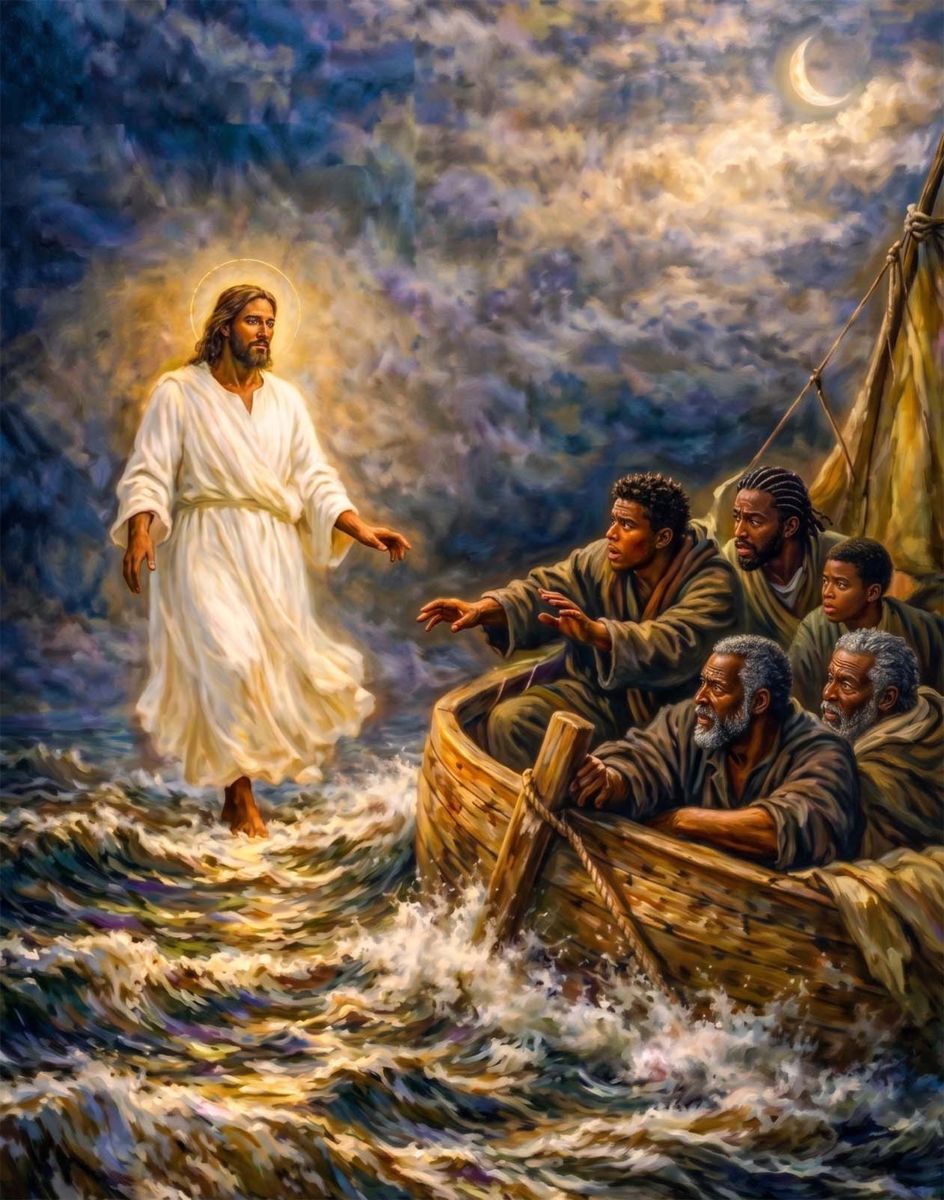
Around the same time, waterman Buddy Jones spotted Thompson’s boat drifting. The motor to the skipjack had failed, and the cloth sails were wet. Jones found a line to tow the boat in, but it wasn’t thick enough. Meanwhile, in the span of about two hours, the wind gusted from 10 knots to hurricane-like gales, and Jones wasn’t sure he could get back. He told Thompson he couldn’t take the boat and offered the men passage on his vessel, according to an account in the Salisbury Times. Refusing to abandon his vessel, Captain Thompson fought desperately to save the boat he loved. In the end, both he and his crew were claimed by the icy waters, disappearing beneath the storm-driven Chesapeake in one of the Bay’s tragic reminders of the peril faced daily by its watermen.They stayed with their captain. “We’re going to try to save her,” Thompson told Jones, according to the newspaper.
That evening, Esther called William to say the boat hadn’t come home. Aftermidnight, they learned there were no survivors. The boat itself was more fortunate. Rescuers pulled it up, and investors bought it to restore. Eventually, it landed at the museum.
Ps 116:15 (KJV) Precious in the sight of the LORD is the death of his saints.
Uncovering the untold stories of watermen and women on the Chesapeake
By Megan Sayles
AFRO Staff Writer
msayles@afro.com
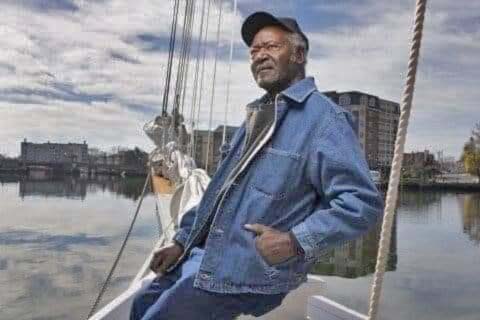
The late "Vincent Leggett," named admiral of the Chesapeake by former Maryland Governor Parris N. Glendening in 2003, dedicated his life to preserving and amplifying the stories of free and enslaved African Americans who were the backbone of Maryland’s seafood and maritime industries. His organization, Blacks of the Chesapeake, has been documenting the impact and contributions of Black sailors, oystermen, crabbers, longshoreman, sailmakers, boat builders and more since 1984.
Top of Form
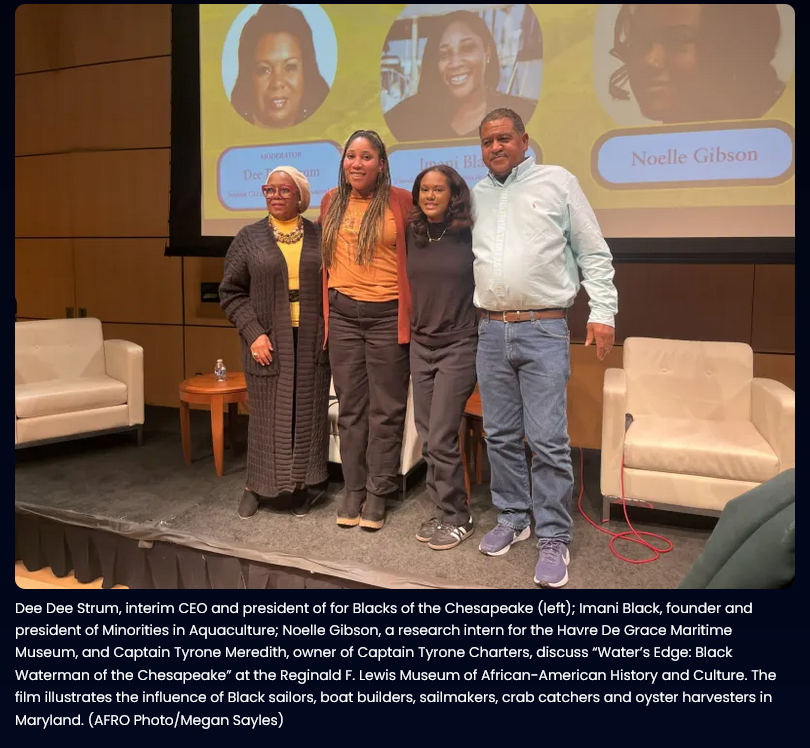
Bottom In 2023, Leggett and other Marylanders dedicated to carrying on the legacy of these unsung trailblazers became subjects of Alexis Aggrey’s documentary film, “Water’s Edge: Black Watermen of the Chesapeake.” On Feb. 1, the Reginald F. Lewis Museum of African-American History and Culture and the Institute of Marine and Environmental Technology (IMET) held a screening and panel discussion for the film, inviting the public to learn more about these untold stories.
“I wan to be clear, not only were we pioneers in running boats and picking houses– we were leaders. We were owners in these areas— owning boats, building boats, making sails, owning picking houses and the like,” said Drew Hawkins, chair of the Reginald F. Lewis Museum’s board of directors. “We crafted terms that are popularly used today when we talk about crab meat. Our impact has really been far and wide.”
Some of the pioneers covered in the film included Captain George Brown, the Turner family of Talbot County and Downes Curtis. Under the segregation of Jim Crow America, Brown amassed enough capital to acquire a steamboat, the “Starlight,” and a beach, which he named Brown’s Grove. In 1914, he began transporting African-American families to the Anne Arundel County beach for day trips during a time when they were not welcome at popular beaches, like the Tolchester Beach Amusement Park.
The Turner family, seafood legends of Bellevue, Md., were property owners, crab and oyster traders and boat builders. They ran two notable seafood processing houses, W.A. Turner and Sons and Bellevue Seafood Company, from the mid to the late 1900s. The success of the enterprises, which employed many of the town’s residents, made the predominantly Black community self-sufficient.
Curtis, of Oxford, Md., and his brother, Albert, learned sailmaking from Englishman Dave Pritchett. Following Pritchett’s death in 1936, the brothers carried on his work running a sail loft. The Curtises became renowned for their sails, cutting them for noteworthy figures like the Kennedy family and actor Jackie Gleason.
Today, watermen, like Captain Tyrone Meredith, have made careers out of running charter boats for people interested in fishing. The fifth generation fisherman operates the longest headboat in the Kent Narrows fishing fleet, the “Island Queen.”
The sreening of “Waters Edge: Black Waterman of the Chesapeake” was held in memory of Leggett, who died in 2024 at age 71. A Baltimore native, Leggett penned two books to expose readers to the contributions of African Americans in the seafood and maritime industries, “Blacks of the Chesapeake: An Integral Part of Maritime History,” and “The Chesapeake Bay Through Ebony Eyes.”
One of his greatest achievements was a 17-year campaign to preserve the last five acres of the once 180-acre Elktonia Beach, an Annapolis property purchased by formerly enslaved man Frederick Carr in 1902. The spot became a flourishing resort for Black beachgoers. Leggett led an effort to save the beach from development, and it was instead turned into a public park.
“Vince would have been over the moon,” said Aldena Legget, his wife, at the screening. Vincent Leggett died on Nov. 23, 2024. “This is what he loved. He loved history. He loved Black history.”
Dee Dee Strum, interim CEO for Blacks of the Chesapeake, described Leggett as a humanitarian and boundary crosser.
“He felt that the story of African Americans as major contributors to establishing Maryland as a global powerhouse for sailing, the seafood industry and the maritime industry needed to be told. All of that was fueled originally by enslaved Africans who actually were brought here by written orders,” said Strum. “They wanted persons from African tribes brought
The last Blackjack, Skipjack captain on the Chesapeake Bay Kermit Travers
here to this region who had experiences in working the waterways in Africa.”
Considering the substandard health of the Chesapeake Bay today, Strum said the organization’s top priority this year is pushing environmental justice, the larger umbrella of Leggett’s work. She wants to ensure there is a pipeline for youth of color to become environmentalists and restore the bay.
This becomes even more critical as the historical denial of access to public pools and beaches for African Americans has perpetuated a stereotype that Black people don’t like the water, according to Strum.
“We have to make way for them to feel welcomed at the waterways,” said Strum “This is their bay. It’s our bay. It’s everyone’s bay.”

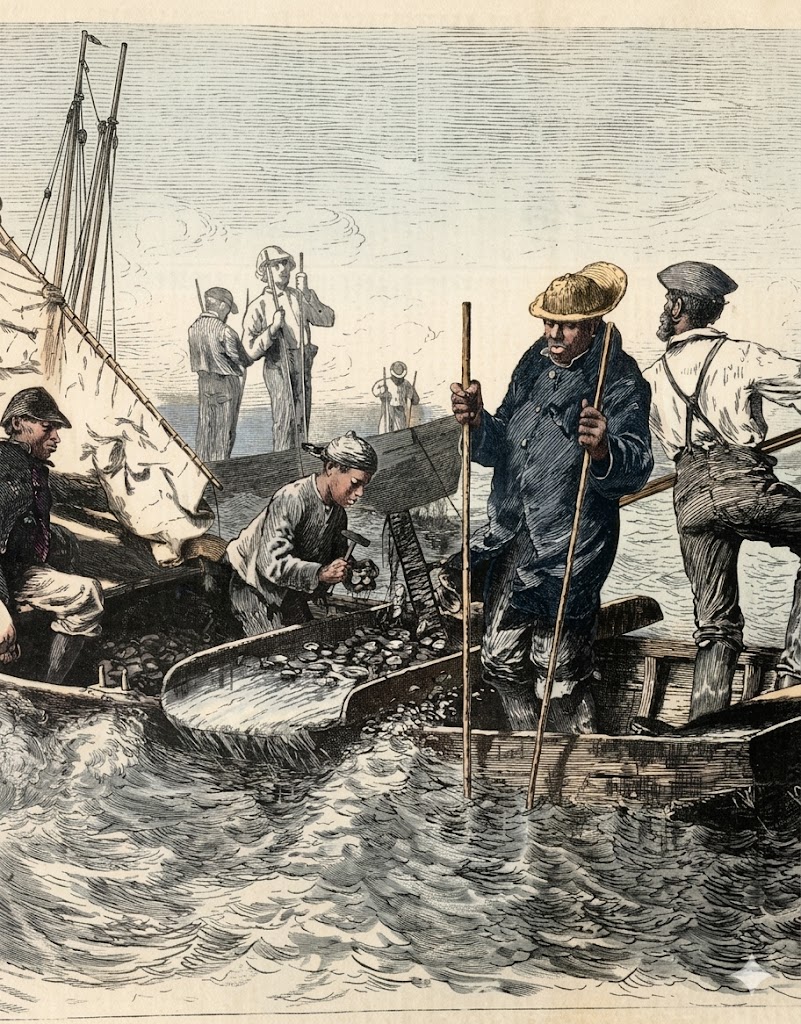 often referred to as "Black Jacks" ( Black Jacks" was a nickname for African-American sailors who served on American merchant, sailboats, vessels during the 18th, 19th and 20th centuries) —found a rare degree of economic independence and dignity on the water, even during the era of slavery.
 Deal Island was home to thriving Black communities, particularly in areas like Dames Quarter and Wenona.





 beds, tonged in the shallows, and labored through long seasons shaped by weather, markets, and the rhythms of the water. Their knowledge of currents, shoals, and harvest grounds was earned through experience and passed down through generations.
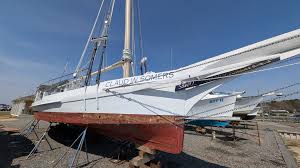
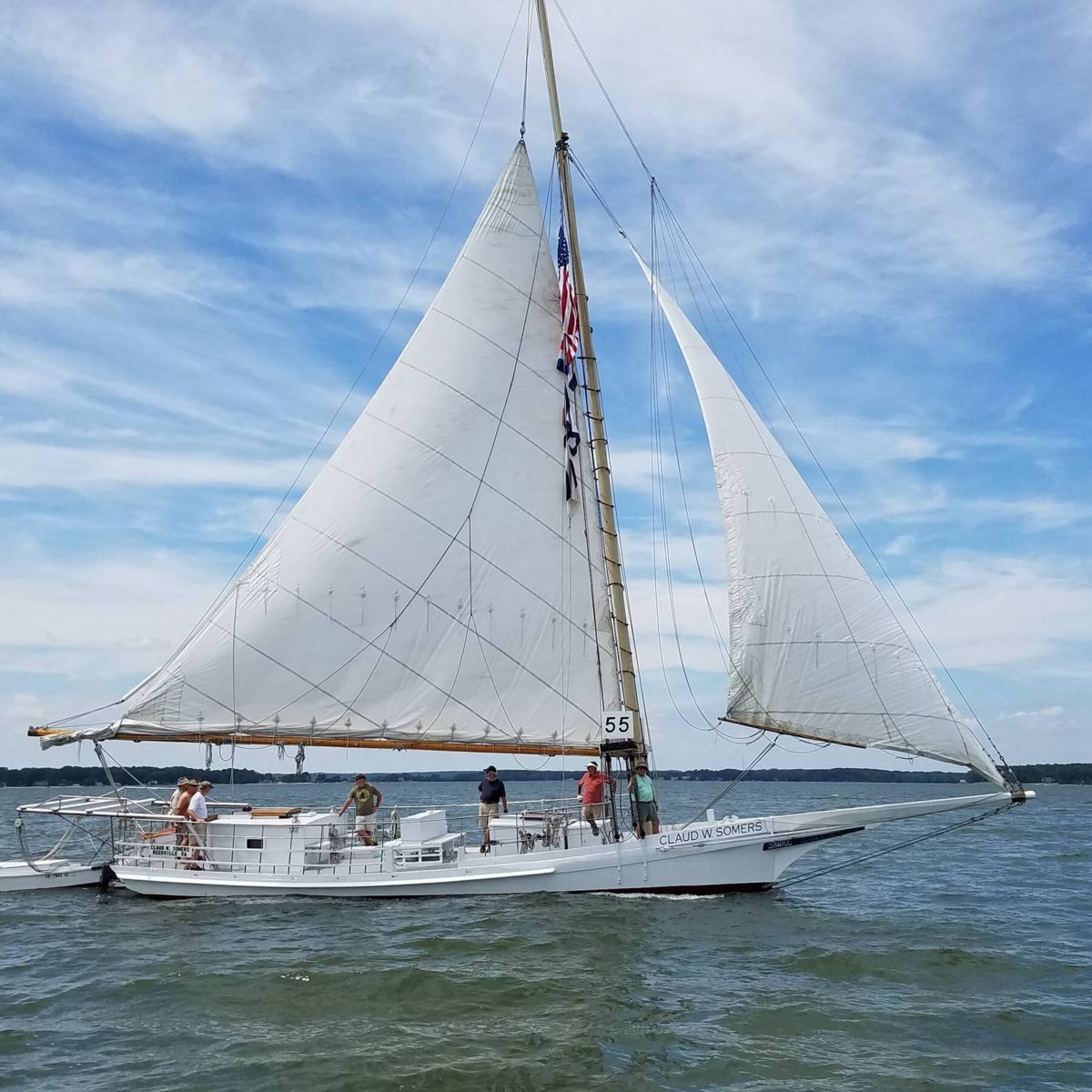
 Following the tragedy, the vessel was eventually salvaged and changed hands several times. In 1983, it was purchased by Alfred Garey Lambert, who spent 17 years restoring it.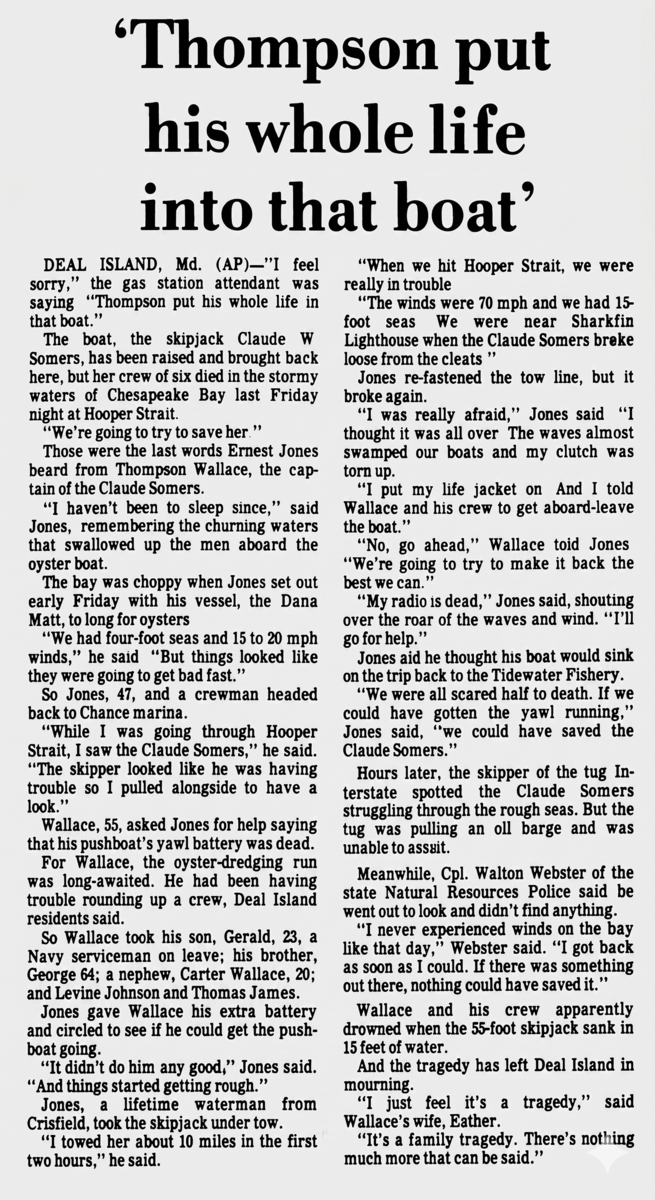
 While working the Bay, Captain Thompson’s yawl boat reportedly developed engine trouble. Soon stranded in the mounting storm, the skipjack began taking on water as increasingly violent seas crashed over her decks. Fellow watermen made repeated attempts to reach and rescue the crew, battling freezing temperatures and dangerous waves, but the conditions proved overwhelming.
 but by the time Kevin reached home, he said, the winds had calmed. He wondered if his father had come in.
  about two hours, the wind gusted from 10 knots to hurricane-like gales, and Jones wasn’t sure he could get back. He told Thompson he couldn’t take the boat and offered the men passage on his vessel, according to an account in the Salisbury Times.
 In 2023, Leggett and other Marylanders dedicated to carrying on the legacy of these unsung trailblazers became subjects of Alexis Aggrey’s documentary film, “Water’s Edge: Black Watermen of the Chesapeake.” On Feb. 1, the Reginald F. Lewis Museum of African-American History and Culture and the Institute of Marine and Environmental Technology (IMET) held a screening and panel discussion for the film, inviting the public to learn more about these untold stories.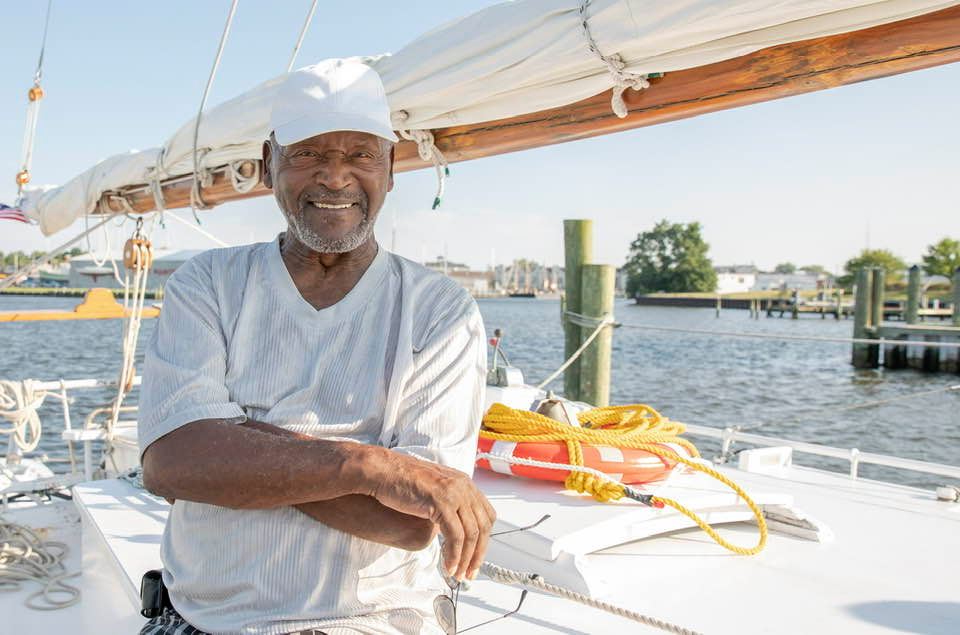
.png)